
 Overtonium, a 32-partial additive overtone synthesizer
32-partial overtone synthesizer
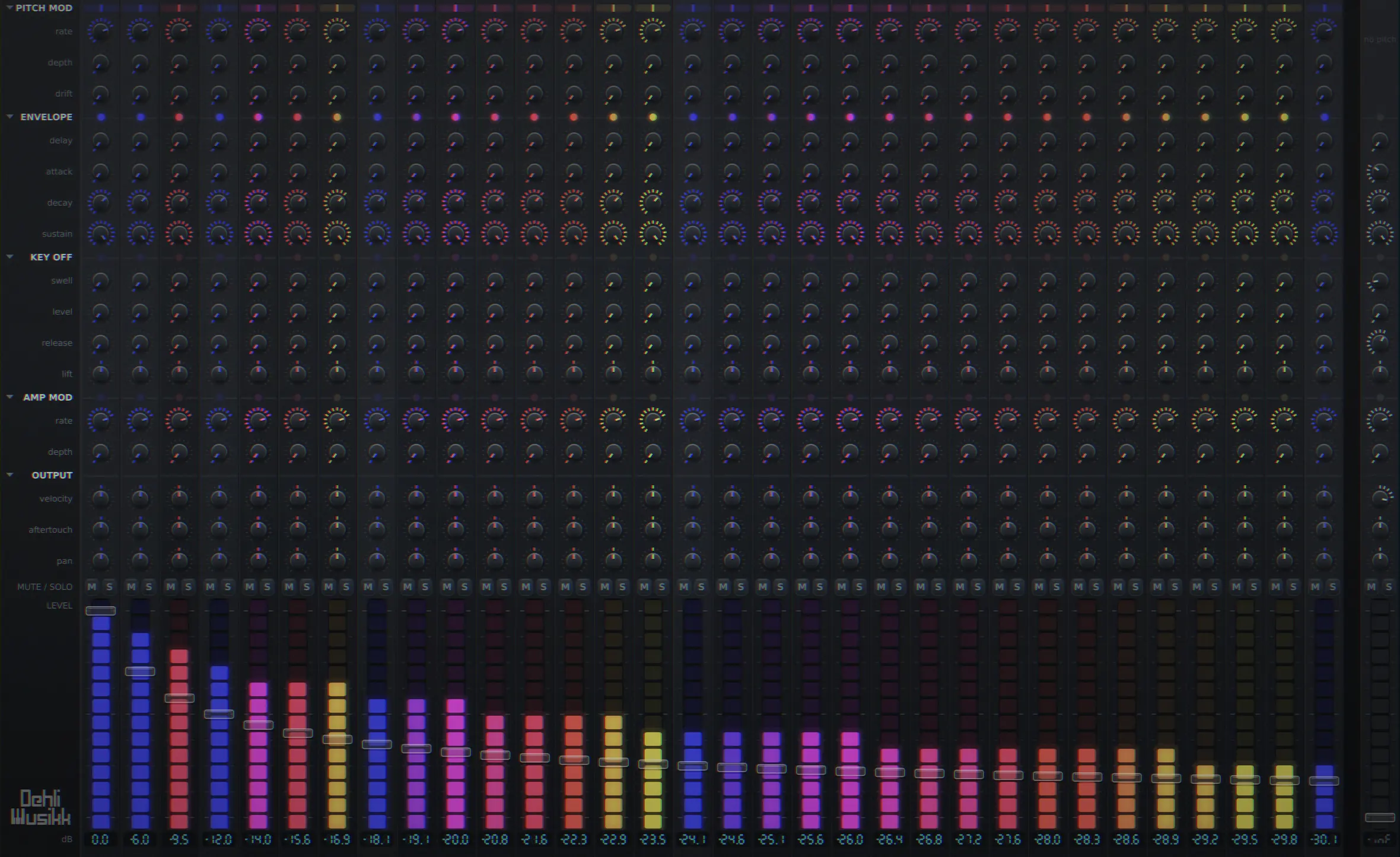
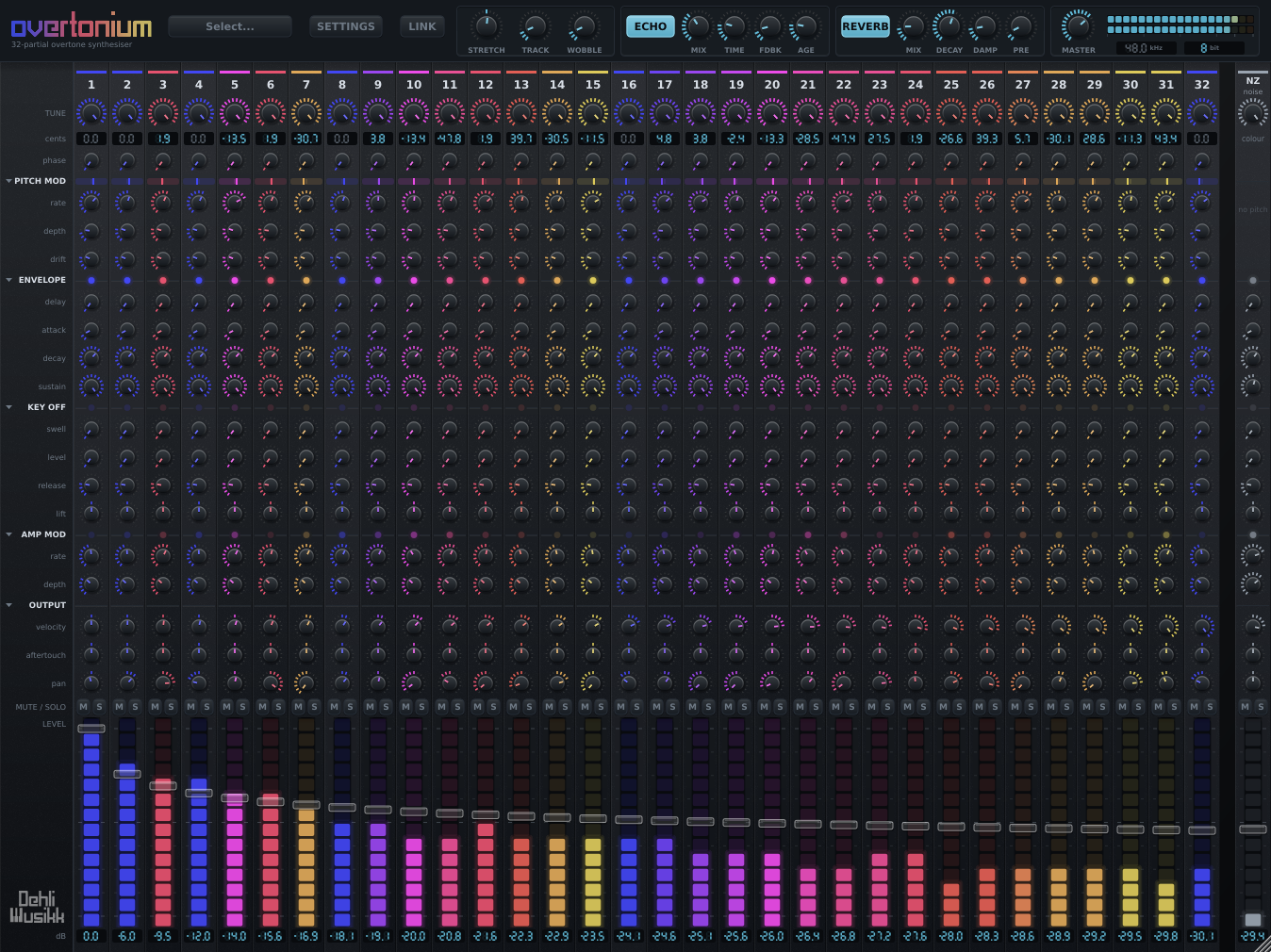
An additive synthesizer laid out like a 32-channel mixer. Every channel is one sine oscillator locked to a harmonic of the played note, and every channel has its own tuning, envelope, modulation and place in the stereo field.
- Formats
- VST3, Standalone, AU on macOS, LV2 on Linux
- Platforms
- macOS, Windows, Linux
- Partials
- 32, plus a noise channel
- Licence
- AGPLv3
Additive synthesis usually hides its partials behind a spectrum drawing or a handful of macro controls. This puts all of them on the surface, as faders, and gives each one the controls a channel on a desk would have. Shaping a sound is mixing it.
What it sounds like
Eleven of the thirty-four factory presets, played on an Expressive E Osmose, with nothing on the output but the plugin's own effects. Everything else on this site you can listen to is the plugin rendering a chord to a file, which is what keeps those clips honest and also what stops them showing what any of this does under hands. This is the one recording of it being played.
The presets page has a chapter link for each of the eleven, and a clip of every one of the thirty-four presets.
The control worth reaching for first
TUNE sweeps each partial continuously between equal temperament and just intonation. At the just end the partial sits at an exact whole-number ratio with the fundamental and the whole stack fuses into one timbre. At the equal end each partial snaps to the nearest semitone and the same stack smears into a chord.
Two of the factory presets, Just Saw and Equal Saw, are identical except for that one control. They sound nothing alike.
Just Saw
Equal Saw
Nothing about the tuning is hard-coded. For harmonic n the just interval is 1200 * log2(n) cents,
the equal position is that rounded to the nearest semitone, and TUNE dials in the remainder.
The tuning system works through it, along with stretch, the six keyboard temperaments and keyboard
tracking.
Where to go next
- TuningTUNE, inharmonic stretch, six historical temperaments on any root, and how the spectrum thins as you play up the keyboard.
- ControlsEvery knob on a channel strip, then the effects on the bar and how to play it from a keyboard, a host or a controller.
- PresetsThe thirty-four that ship, what a preset carries, and where your own are kept on each platform.
- InstallInstallers for macOS and Windows, a zip for Linux, what to do when a host does not see it, and building from source.
What changed in each version, newest first, and what to know before upgrading are on the releases page.
Questions
- Which hosts does Overtonium run in?
- It builds as a VST3 on macOS, Windows and Linux, an Audio Unit on macOS and an LV2 on Linux, so it loads anywhere those formats do. There is a standalone build as well.
- Is Overtonium free?
- Yes, and free software rather than only free of charge. It is released under the AGPLv3, which follows from JUCE, and the whole source is on GitHub.
- What is additive synthesis?
- Building a sound by adding sine waves together rather than by filtering a rich one down. Every timbre is a stack of partials at different frequencies and levels, and additive synthesis hands you those partials directly. Overtonium gives you 32 of them, one per mixer channel.
- Can Overtonium do microtonal tunings and just intonation?
- Both, and separately. TUNE sweeps each partial between its equal-tempered position and its exact whole-number ratio. The keyboard underneath is tuned on its own, to equal, just, Pythagorean, quarter-comma meantone, Werckmeister III or Young, on any root, at any reference pitch from 415 to 466 Hz.
- Does Overtonium support MPE?
- Yes. With MPE switched on, pitch bend and pressure arrive per note, and pressure has its own amount on every one of the 33 channels. An ordinary single-channel keyboard plays either way.
- Can I play Overtonium from a MIDI controller?
- Yes. Right-click any control, choose MIDI Learn and move a knob or fader on the controller. The map is saved with your project rather than with the preset. A macro moves a whole row from one parameter, so one controller or one automation lane can reach up to 32 controls at once.
- Does Overtonium have portamento or glide?
- Yes, on every channel separately. Each partial slides to a new note over its own GLIDE time, so the series can arrive a partial at a time. Two switches cover every channel: whether it glides always or only legato, and whether it moves at a fixed rate or takes a fixed time. Glide on the Playing page has the rest.
- How much CPU does Overtonium use?
- Eight voices of 32 partials each, with every modulator running, costs about 7% of one core, and sixteen voices about 14%. Turning the render rate down is a real saving: at 8 kHz the whole voice pool costs a fifth as much. The figures in full are on the install page.
Where it came from
Overtonium is the fourth instrument in a line, and the first that computes its sound rather than playing it back. The two ideas it is built on both arrived at the same place, sitting at a drawbar organ, and neither of them is really about organs.
The first was the Voltage Controlled Cassette Organ, in 2023. A Korg CX-3 sampled through cassette tape, every note of every drawbar recorded as its own file. The tape was the point of it: wow, flutter and random warbles gave the organ a movement like a chorus or a rotary speaker, but without the fixed rate a modulation effect has. It was recorded to tape twice, which doubled it, and because no tape deck plays back the same way twice the two passes never quite agreed with each other.
Strykebrett came in October of the same year, a sampled Logan String Melody II. Six faders rather than nine drawbars, each setting the level of one octave or one of the voices across a bass and a treble section, and four of them carrying their own envelope and their own LFO. It is not an organ, which is the useful thing about it: the workflow survived being moved onto something else.
EDB-Orgel followed in 2024, keeping the drawbar workflow and putting four digital synthesis types under it instead of an organ.
All three gave a drawbar its own envelope and LFO, which is the first of the two ideas. A drawbar is a partial, and an organ moves them by hand while the note sounds. Nine of them shaped separately already sounds unlike an organ, so thirty-two, each with a full channel of controls, is that idea taken as far as it goes.
The second idea is about where the drawbars are tuned. A drawbar is a harmonic, but an organ has only the twelve notes of the keyboard to build one out of, so each drawbar is put on the nearest one. The second, fifth and eighth are all fifths an octave apart, which means holding a C puts three G's into the sound. A harmonic series does not work like that. The real intervals are whole-number ratios, 2:1, 3:2, 4:3, and apart from the octaves none of them lands on a key. TUNE is that difference turned into a control, and computing the partials is what makes it possible: a sampled one is stuck at the pitch it was recorded at, while a computed one can sit where the organ would put it, at its exact ratio, or anywhere between.
The ancestry shows up in the details. DRIFT is the cassette's random warble, per partial. WOBBLE is the same thing under the whole instrument. The tape echo's two paths, each with its own motor speed and its own random stream, are the double tracking, and its AGE control never quite reaches zero for the same reason the two tape passes never agreed: a transport that held speed exactly would put the repeat back in mono, and there is no such transport.
All three earlier instruments are sample libraries with a plugin wrapper, sold at Dehli Musikk. This one is free software, and none of their code is in it.